
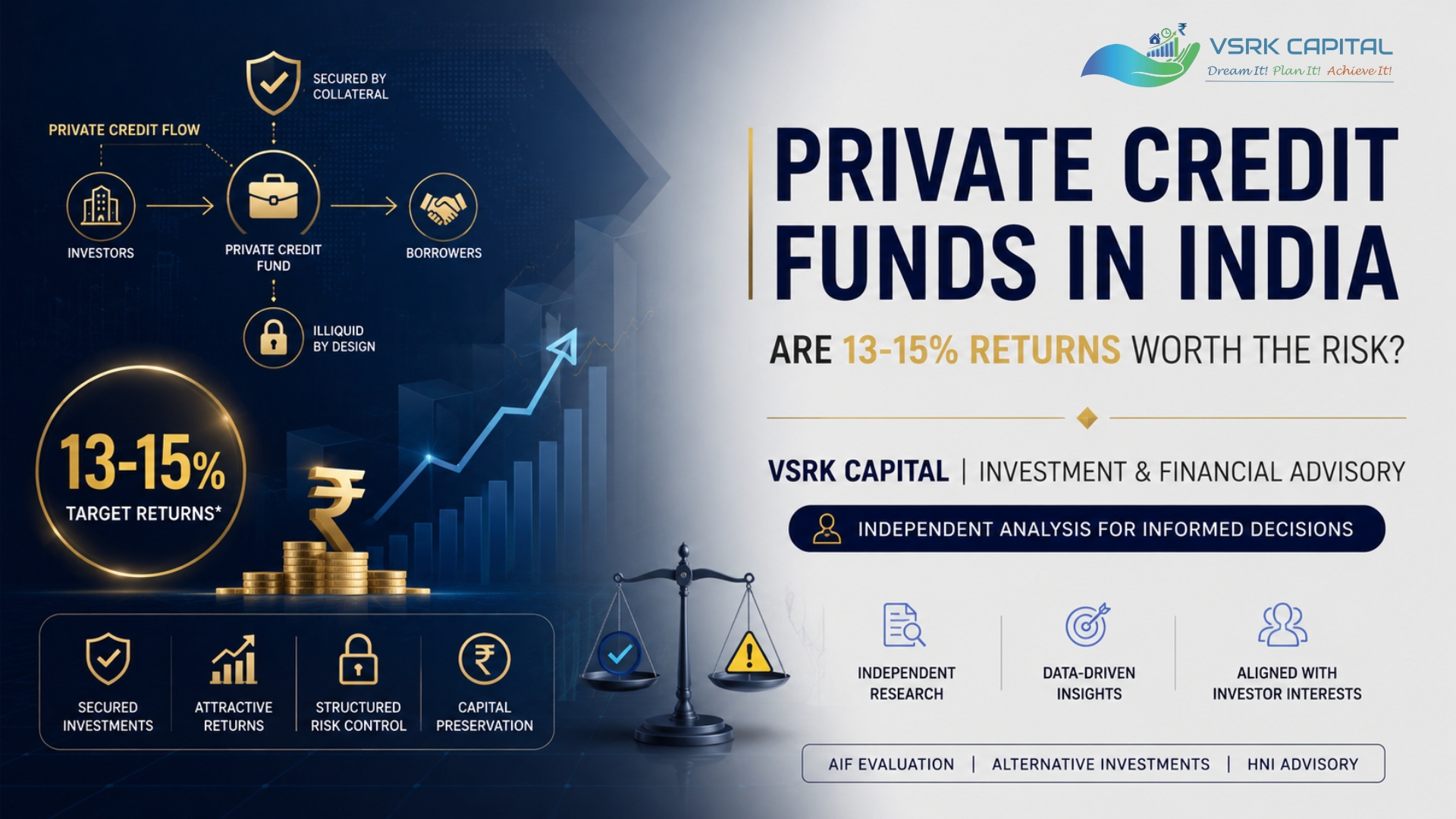

In a world where fixed deposits offer 7 percent and equity markets deliver volatile returns, a financial product promising 13 to 15 percent per annum tends to stop people in their tracks.
Private credit funds have been doing exactly that across India in 2026. Family offices, HNIs, and even first-time alternative investors are increasingly being approached with this proposition. The numbers sound compelling. But before you write a cheque, you need to understand exactly what you are buying into.
What Is a Private Credit Fund?
A private credit fund is a Category II Alternative Investment Fund (AIF) regulated by SEBI. Instead of investing in listed equities or bonds, it lends money directly to companies that cannot access traditional bank financing. These are often mid-sized businesses, real estate developers, new-economy platforms, and infrastructure companies that need flexible, structured capital quickly.
Banks, bound by standardised underwriting frameworks and regulatory caps, often cannot serve these borrowers. Private credit funds step in with customised loan structures, bespoke repayment schedules, and collateral-backed agreements. In exchange for this flexibility and risk, they charge higher interest rates. That premium flows to the investor as return.
India’s private credit market is currently estimated at around $25 billion and growing rapidly. Global institutions, including KKR, have launched dedicated Asia-Pacific funds with India as a primary focus. The opportunity is real.
The Case For: Why Investors Are Paying Attention
The return profile is the obvious starting point. In a market where debt instruments rarely cross 8 to 9 percent, a well-structured private credit AIF targeting 13 to 15 percent IRR offers a meaningful premium.
Beyond returns, private credit offers predictable cash flows. Unlike equity, which is subject to market sentiment and price volatility, private credit generates interest income on a structured timeline. Many funds offer quarterly distributions during the tenure of 3 to 5 years, providing income visibility that equity simply cannot match.
The structural safeguards are also stronger than most investors assume. Deals are typically secured with collateral, escrow mechanisms, personal guarantees, and financial covenants. Recovery frameworks under the Insolvency and Bankruptcy Code have also matured significantly, improving the lender’s ability to enforce claims.
The Case Against: What the Brochure Does Not Tell You
Here is where careful reading matters.
Private credit is illiquid by design. Your capital is locked in for the fund tenure. There is no exit window, no secondary market, and no ability to redeem early in most structures. If your financial circumstances change midway, you cannot access your money.
Credit risk is real. The companies borrowing from private credit funds are doing so precisely because traditional lenders declined them. That does not make them bad businesses, but it does mean the due diligence burden is high.
Regulatory asymmetry is a growing concern. Unlike banks and NBFCs, private credit funds operate under far less stringent oversight. There are no uniform credit appraisal standards, no mandatory NPA reporting norms, and limited disclosure requirements. The RBI flagged systemic risks from private credit opacity as early as 2024 and the conversation has only intensified in 2026.
Tax treatment is another consideration. Income from Category II AIFs is taxed as pass-through income at the investor’s marginal rate, which for most HNIs stands at approximately 39 percent. The post-tax return at 13 to 15 percent gross may look meaningfully different once tax is applied.
So Are the Returns Worth It?
For the right investor, yes. For the wrong one, absolutely not.
Private credit belongs in a portfolio where the investor has a high net worth, a long investment horizon, no near-term liquidity needs, and the risk appetite to absorb a potential default scenario. It is not a replacement for mutual funds or fixed income. It is a complement to a diversified portfolio, not the foundation of one.
The minimum investment in most private credit AIFs starts at Rs. 1 crore. The commitment is typically 3 to 5 years. The fund manager’s track record in credit underwriting and recovery matters more than the headline return figure.
At VSRK Capital, we help investors evaluate alternative investments like private credit with complete transparency. Our role is to ensure that every investment you make is aligned to your actual financial goals, risk capacity, and liquidity requirements.
If you are being offered a private credit product and want an independent assessment before committing, speak with us first.
Disclaimer: This content is for educational and informational purposes only. It does not constitute financial, legal, or investment advice. Investments in Alternative Investment Funds are subject to market risks and are suitable only for sophisticated investors. Please read all scheme-related documents carefully before investing. VSRK Capital is an AMFI Registered Mutual Fund Distributor. ARN 96373..