

Somewhere between a Monday morning commute and a late-night deadline, a thought crosses the mind of thousands of Indian professionals every single day.
What if I never had to do this again?
That thought is no longer just a daydream. It has a name, a formula, and a growing community behind it. It is called FIRE, which stands for Financial Independence, Retire Early. And in 2026, it is one of the most searched financial topics among Indian millennials in the 28 to 42 age group.
But here is where most conversations go wrong. People hear “retire early” and picture a beach. What they do not picture is the number. The actual corpus. The hard rupee figure that makes the whole thing possible without running out of money at 55.
Let us fix that.
What FIRE Actually Means in the Indian Context
FIRE is not about stopping all work forever. For most Indian professionals, it means reaching a point where work becomes optional. Where you can choose to consult, teach, freelance, or simply rest, without a salary being the deciding factor in your life.
The idea is built on a simple formula: build a strong enough investment corpus so your money works for you, and your monthly needs can be covered without depending fully on salary income.
The catch is that India is not the United States. India’s higher inflation and longer retirement horizon mean the standard 4% withdrawal rule used in Western FIRE planning needs adjustment for Indian conditions.
The Number: How Much Do You Actually Need?
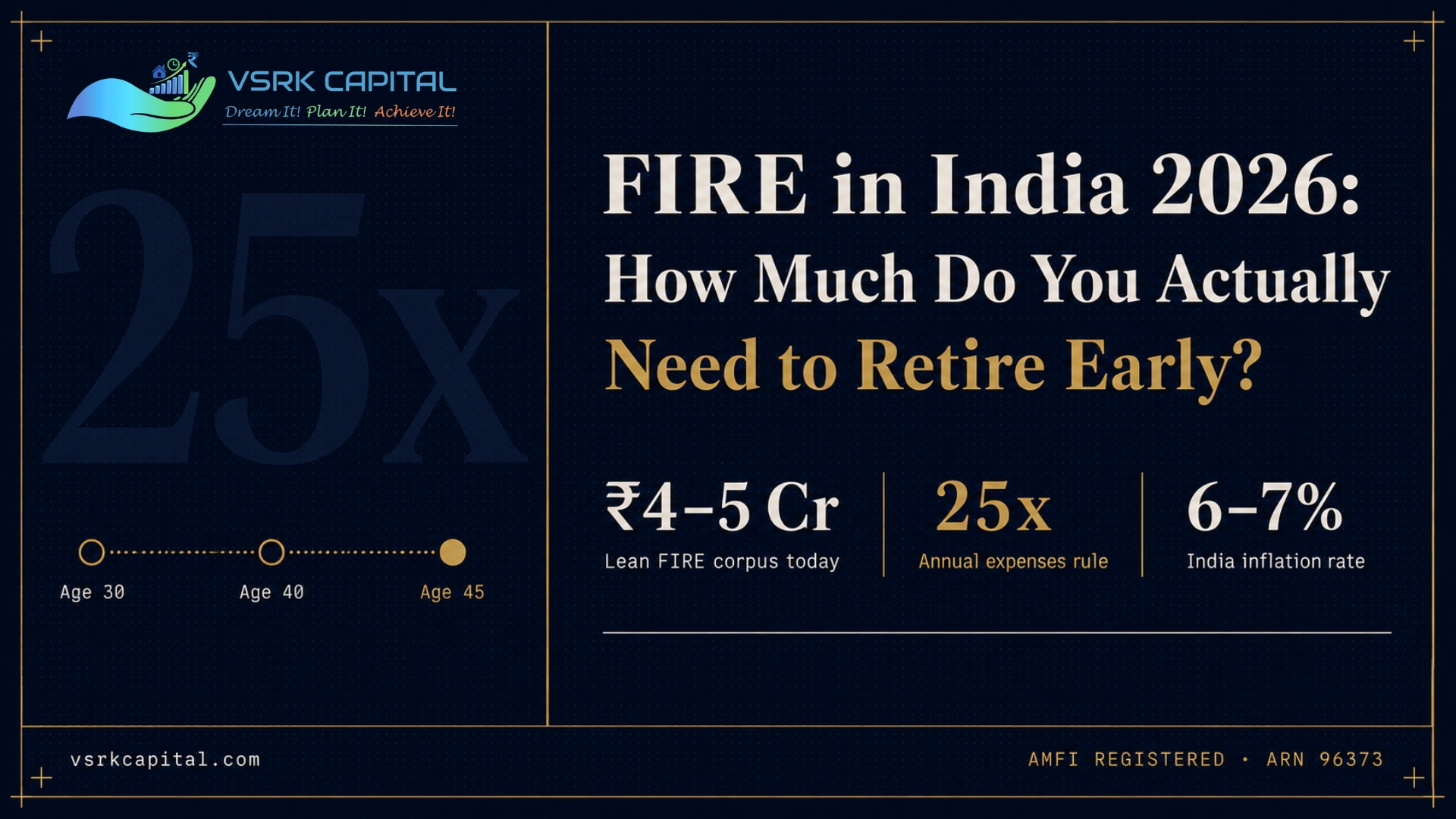
The starting point is the 25x rule. You need 25 times your annual expenses to achieve financial independence. This is derived from the 4% safe withdrawal rate, which means if you withdraw 4% annually from your corpus, it equals one-twentieth of your total portfolio.
Here is how it looks in practice:
If your monthly household expenses today are Rs. 75,000, your annual expense is Rs. 9 lakh. Applying the 25x rule gives you a FIRE corpus of Rs. 2.25 crore in today’s money. But India’s inflation runs at 6 to 7 per cent annually. By retirement, that Rs. 9 lakh annual expense will have compounded significantly, and your corpus must grow through your retirement, not just stay stable.
For a household spending Rs. 1 lakh per month in today’s money, a reasonable FIRE target is Rs. 4 to 5 crore in today’s terms, accounting for India’s higher inflation and a retirement that may need to last 35 to 40 years.
In nominal terms, 15 to 20 years from now, after inflation adjustment, that number looks closer to Rs. 10 to 15 crore.
The Three Types of FIRE Every Indian Should Know
Lean FIRE is early retirement on a stripped-down budget. Essentials only. Lower corpus required, but lifestyle is constrained. Lean FIRE typically uses a 15x multiple of your inflation-adjusted annual expenses.
Regular FIRE is the middle path. Comfortable lifestyle, moderate spending. The 25x rule applies here.
Fat FIRE is retirement with your current lifestyle fully intact, including travel, private schooling, good healthcare, and discretionary spending. Fat FIRE uses a 50x multiple of your inflation-adjusted annual expenses, making it the hardest to achieve but the most sustainable for urban Indian families.
What Makes India Different
Three factors make FIRE harder in India than anywhere else.
First, healthcare inflation in India runs at 10 to 12 per cent annually, double the general inflation rate. Healthcare costs are the number one reason retirement plans fail, and you should allocate 25 to 30 per cent of your corpus specifically for healthcare.
Second, family obligations do not stop at retirement. Dependent parents, children’s education, and family emergencies are costs that Western FIRE frameworks simply do not account for.
Third, passive income options are limited. Unlike the United States, where dividend-paying stocks and rental income are more accessible, Indian investors must work harder to build reliable post-retirement cash flows.
Is It Actually Achievable?
Yes, for the right person with the right plan.
At Rs. 30 to 50 lakh annual income with a 50 to 60 per cent savings rate and a 15-year investment horizon at 12 percent returns, reaching Rs. 5 to 8 crore corpus by age 45 is mathematically achievable.
The vehicle matters too. Equity mutual funds, index funds, NPS, PPF, and REITs each play a distinct role in a FIRE-oriented portfolio. The right allocation depends entirely on your age, income, risk appetite, and target retirement date.
At VSRK Capital, we help professionals build goal-based portfolios specifically designed for financial independence. Whether you are ten years away from your FIRE number or just beginning to calculate it, we can help you build a plan that is grounded in real Indian financial conditions, not imported assumptions.
Start with the number. We will help you build the plan around it.
Disclaimer: This content is for educational and informational purposes only. It does not constitute financial, legal, or investment advice. Investments are subject to market risks. Please read all scheme-related documents carefully before investing. VSRK Capital is an AMFI-registered mutual fund distributor. ARN 96373.