
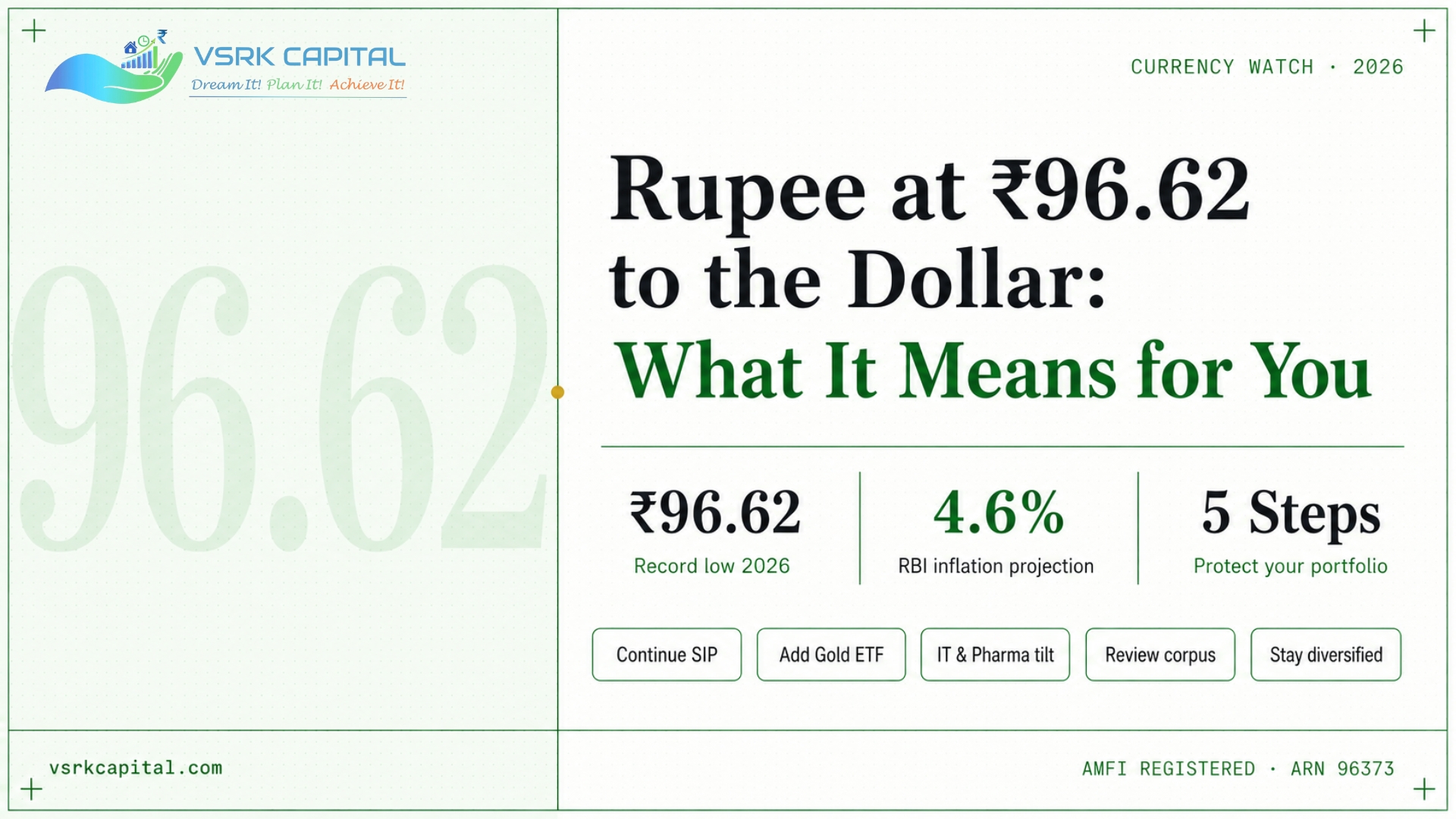

The number on your currency app is not a typo.
The Indian rupee is currently trading at ₹96.62 to the US dollar, hitting successive record lows in recent sessions. For most Indian households, this feels abstract. A currency number. A headline. Something that happens to exporters and importers, not to ordinary investors.
However, here is the reality: rupee depreciation directly impacts your home, grocery bill, fuel tank, and mutual fund portfolio. And in 2026, it is doing exactly that.
Why the Rupee Is Falling
Three forces are working together to push the rupee down.
- First, the US Federal Reserve continues to hold interest rates at elevated levels. When US rates are high, global capital flows toward dollar assets because the returns are attractive and the dollar is safe. Foreign portfolio investors pulled over $18 billion out of Indian equities in 2025 alone. That outflow increases demand for dollars and reduces demand for rupees.
- Second, India’s crude oil import bill has surged alongside rising global oil prices. India pays for oil in dollars. When crude is expensive, India needs more dollars, which puts direct pressure on the rupee. India raised petrol and diesel prices by approximately ₹0.90 per litre for the second time in a single week in May 2026, fuelling fresh concerns over inflation and higher import costs.
- Third, the broader dollar strength story is not unique to India. Most emerging market currencies are facing similar pressure from global capital shifts, and India is not an exception.
What It Is Actually Doing to Your Life
Rupee depreciation is not just a financial markets story. It has already reached your daily expenses in ways that are easy to miss.
Fuel prices have risen directly. Imported electronics, appliances, and components have become more expensive. Edible oil, which India imports in large quantities, has seen price increases. If you are planning to send a child abroad for education, the cost in rupees has gone up significantly, even if the dollar fee has not changed.
The RBI projected 4.6 percent inflation for FY2026-27 in April 2026, already assuming ₹94 per dollar. Daily essentials are minimally affected, but fuel costs and imported electronics show the most visible impact. At ₹96.62, the actual depreciation has exceeded even those projections.
What It Means for Your Investment Portfolio
Here is where most investors need to pay close attention.
- Equity mutual funds: Short-term sentiment is negative. FII outflows triggered by dollar strength create selling pressure in Indian equities. But domestic business fundamentals have not changed. Exchange rate moves affect market sentiment, not domestic business fundamentals. A long-term investor should not exit quality domestic equity positions because of rupee depreciation alone.
- IT and pharma stocks: These are the natural winners in this environment. Companies like TCS, Infosys, HCL Tech, Sun Pharma, and Dr Reddy’s earn in US dollars and report in rupees. Every rupee that weakens improves their INR margins without any change in business performance. Funds with exposure to export-oriented sectors benefit directly.
- Gold: Gold is priced in US dollars. A 10 percent rupee depreciation produces approximately a 10 percent rise in the INR price of gold. Allocating 10 to 15 percent to gold ETFs or sovereign gold bonds is the standard hedge recommended during sustained rupee depreciation.
- Debt funds: Rupee weakness raises inflation concerns, which may delay RBI rate cuts. This creates headwinds for long-duration debt funds. Short-duration debt funds are relatively better placed.
5 Smart Moves for the Current Environment
- Do not panic-exit equity funds. Sentiment-led corrections during currency weakness are temporary. The underlying earnings story of Indian companies remains intact.
- Add gold to your portfolio. If you have less than 10 percent allocation to gold ETFs or sovereign gold bonds, this is the moment to correct that.
- Tilt towards IT and pharma mutual funds. Export-oriented sectors directly benefit from rupee weakness. A tactical allocation makes sense right now.
- Review your foreign education plan. If you are saving for a child’s education abroad, recalculate your corpus target at ₹96 plus to avoid a shortfall later.
- Stay invested in your SIP. Currency cycles are normal and historically temporary. Investors who stay diversified and disciplined are better positioned to navigate volatility and build long-term wealth than those who react to every headline.
The Bottom Line
A rupee at ₹96.62 is uncomfortable. It is not catastrophic. India’s economy continues to grow, domestic consumption remains strong, and the structural investment case is intact.
What the current environment requires is not panic. It requires a portfolio that is positioned correctly for the conditions that exist right now.
At VSRK Capital, we help investors make exactly these adjustments with clarity and confidence. If your portfolio has not been reviewed in light of current currency conditions, this is the right time to have that conversation.
Disclaimer: This content is for educational and informational purposes only. It does not constitute financial, legal, or investment advice. Investments are subject to market risks. Please read all scheme-related documents carefully before investing.