📈 Investing doesn’t have to be complicated. Join VSRK Capital to explore SIPs, mutual funds, and disciplined wealth-building. Backed by 18+ years of trust. Talk to us today and start your journey.

How Financially Compatible are You with Your Partner?

How-Financially-Compatible-are-you-with-Your-Partner

Marriage planning

India is surrounded by traditions and rituals. The marriage season never goes off. Talking about destination weddings or simple marriage ceremonies there is always a bar rising higher than before. 

It is said that marriage is not just a relation between two partners but the entire two families. What’s the main point we look into the partner? Mainly emotional compatibility, secondly understanding. Two individuals are said to be perfectly compatible when they understand each other in every aspect. Apart from emotional compatibility, it’s the financial compatibility that is seen. Financial compatibility helps the partners to live an accomplished life. Many of you think that financial compatibility means both partners have equal money, but it’s not the case. It means what perspective both have towards money and what is the importance of money for them.

Know what money makes to your partner:

Different people have a different value for money. Before getting married, you should know what attitude your partner keeps towards money. Lack of communication can create a sense of misunderstanding between you and your partner. Planning a wedding is not as easy as it seems to be, we can say that it’s a step by step plan. These plans reduce the burden as a whole.

These steps involve-

  1. Setting a budget
  2. The theme of your functions
  3. Preparing guest list
  4. Choosing venue
  5. Inviting the guest

And other small but essential things. Marriage is the most overwhelming activity for couples. The excitement and expectation are to the next level. Imagining a perfect wedding and making your imagination the reality needs a well-planned functioning.

Having a conversation around money with your partner:

When you both come to know each other’s views regarding money, make this topic a part of your regular conversation. The income and how you spend it and also how much you save and through what, these are some common talks that you may include in your common talking. 

Setting a budget includes income ratio and expenditure ratio. Expenses are necessary plus luxury too. Also, your investments will have a glance in your budget. Checking up the bank accounts will help in dealing with various such heads. Deciding a day every month where bank accounts can be checked. This will help in planning a further budget and will rectify if any issue arises.

Arrive at a common goal:

While going your own way of managing money and bank balance, maybe one person is not satisfied with the way of other person management of money. Both have to discuss and mutually agree on common terms, spending, and saving. In case you cannot come to a common and stable decision you can consult a financial advisor. The financial advisor will tell you every detail regarding every possible term and this will then help you to come to a common decision.

Make the other person accountable:

When both of you, you and your partner come upon a middle ground decision, it is important that you keep your partner accountable. Don’t make your partner feel like his/her opinion was not considered. Communication is the key to a healthy marriage life. It will ensure that you are on the right path.

Conclusion:

Financial compatibility plays an important role in couples. Don’t let financial incompatibility be the reason for issues in your relationship. All the above factors will help you to grow your financial compatibility and will help you in the present and future too.

How to Save Money For a Child’s College Education

Save Money For a Child's College Education

Education is one the most powerful weapons in today’s competitive world. We live in an environment where change is constant. Education prepares us for coping with these changes around us. In simple words education is the quality of one’s life; how a person lives, talks and treats others around him/her.

A Good education is important for all of us. A proper education usually involves huge sums of school, college and tuition fees. Good education never comes free. Just like money is important for our day to day needs, similarly, money is very important for higher education. Not only knowledge, but values and moral habits too comes with our learning. For a rich and highly esteemed family, it is easy to spend money, but for an average middle-class family, it is important to maintain a proper system of their income and spending.

If you are a new parent, your child is young, it is beneficial to start saving for your child’s college education from today. This will not only reduce your burden in the future but will also be healthy for your expenditures. In many Indian families, it is often seen that the parents are not very highly educated but they want to make their children do well. But due to less income, they can’t afford the fees of the colleges. For such conditions, the loan facility is becoming common nowadays. Most Indian families face financial problems in regard to their child’s education, this problem is overcome due to loan facility, which is beneficial for the parents as well as children. However, the interest rates on such loans are very high which puts a big burden on the shoulders of the children and their families. 

If you are aiming to make your children study in a well-known institute, the best way is to start early savings. As early as you will start to save the better it will be. Ideally, you should start when your child is born. Even small savings each much can help a lot. Also, it is important to invest in assets and get a great return. Mutual funds are the best option for investing your money. Long-term investments are generally time-consuming but are worth your money and time. Proper investment and high returns are the essential steps towards your child’s dream. In between the savings and expenditures, don’t make it complicated that it leads to loss of your major part of income. We can help to formulate a plan by giving the best advice that will protect your income from the loss and will give you a better version of savings for your child’s college education.

According to the experts, if you have 12 to 15 years for your child’s college education, equity funds are the best option. Also, one of the effective ways to save for your child’s education and future is to create a savings account for your child and start depositing the amount regularly. It will be an easy and convenient way of saving for your child’s future. There are certain children’s education plans which guide you with what to do and how to save your money for educating your children.

Having a good and pre-planned child education policy can also be helpful for you and your children. Every parent wants a safe and secure future for their children. A bright future is not possible without the light of education and knowledge. Make your child’s education your first priority, control some not-so-important expenditures and put those in your child’s education savings.

Financial mentor like ourselves will give you a well-planned estimation providing you the best advice that will be helpful for you as well as beneficial for your future. Income, expenditure, and savings, balancing these three can make your present and future on track.

Education is a light that guides your future but doesn’t come without a cost. Making this cost worth spending, your aim should only be on acquiring education. At an early age, during school days children start to build their dreams. The fulfillment of these dreams depends upon his/her higher education so you can’t compromise regarding education. Your child’s dreams are precious, make them come true by saving accurately for your children’s college education because education needs no compromise so every parent needs to save for their children.

How Much Should a Couple Save For Retirement ?

How Much Should a Couple Save For Retirement

Retirement means a permanent leave from a particular job or a working place. At a young age when you are doing any job or work, you earn income which is satisfactory over your expenses and lifestyle. On the other hand, life after retirement is not exactly a joy ride. Not only do you have to change your lifestyle but also have to balance your expenses and needs. In your early year when you save some part of taxable income, these savings will surely help you in your future. Most of you can’t judge how much to save your income for future use. Some experts suggest that one should invest at least 15-20% of their monthly income towards retirement funds. For working couples, mutual decisions and understanding play an important role to decide the lifestyle after retirement.

Couples planning for retirement have to face certain challenges at their age. It is said that at the age of 40 you make real money. Making decisions regarding your money is not easy. There are certainties, possibilities, and also uncertainties. Retirement requires balancing between these. Your lifestyle portrays the estimation of money that you will need. Try to save 15% of your income per year. Keep that as your ‘savings for retirement’. Retirement involves a combination of personal planning and financial planning.  Retirement planning includes calculation of expenses, identifying the income sources, and programming the savings. 

The process of retirement planning can be held by the professionals called retirement planner by the national association of personal financial coach. You can approach an experienced retirement planner such as ourselves. Also, there is a retirement calculator that can help you in estimating how much money you need before retirement and how to make plans for it. It is easy when you have to plan a retirement as an individual but is a little difficult couple. This is because you both differ in spending, needs, income. There are certain points which must be crystal clear between you both, like-

“How you want to spend the rest of your life after retirement?”

“where you want to live after retirement?”.

“What you want to do after we get to retire?”

Being a working couple and planning to retire, you must plan the spending and prepare a budget for your upcoming life probably after retirement. The option for you is the retirement planner. A retirement planner will help you in the ways you could never plan. Retirement planning must be efficient and worth executing, which can be done by a planner.

Considering the age and health difference one of you may live longer than the other, keeping all these points under consideration, one must plan for the retirement. When it comes to a well-planned future after retirement, you should always take some good advice from a professional i.e., retirement planning advisor. A retirement planning advisor gives you a piece of suitable and effective advice regarding your plans, expenses, savings, and income.

Keeping his advice in mind, you can put up your requirements, needs, and other relevant details in Infront of the retirement planner. keeping in mind all your points, he will formulate a perfect plan for your future (life after retirement). For a working couple, best way to secure their futures are investment and assets. One should invest in money plans and long term-investments.

Keeping some part of your income for investment will be beneficial. Investments are long term as well as short term. Long term investments are mostly beneficial. Investing in funds and policies will give you a satisfactory result after a certain point in time. With the growing age, consciousness regarding health rises. Your saving and investment can come at the time of a health emergency.

Consulting with a retirement planner will reduce your stress as planning is the first step of every activity we do. Making a complete retirement plan will give you a clear vision of your life before and after retirement. The Future is uncertain and unpredictable so we should always be ready for the challenges. Life after retirement is much more tough and full of challenges. Retirement planning, planners, and advisors make your future bright and also less stressful, leading a well-planned life after retirement.

The Complete Beginner Guide to Budgeting

Beginner Guide to Budgeting

In today’s fast-paced world, managing your finances has become more crucial than ever. Whether you’re looking to save for a dream vacation, pay off debts, or simply gain a better understanding of your spending habits, creating a budget is the foundation of financial success. If you’re new to budgeting, fear not! This informative and human-friendly guide will walk you through the basics of budgeting and help you get started on your journey towards financial stability.

Understanding the Basics of Budgeting

Budgeting is essentially a plan for your money. It’s a tool that helps you allocate your income to various expenses and financial goals, ensuring that you have a clear overview of where your money is going. The ultimate goal of budgeting is to spend less than you earn and make intentional choices about your financial priorities.

Creating Your Monthly Budget

  1. Calculate Your Income: Begin by determining your total monthly income. This includes your salary, any side gig earnings, and other sources of income. This step will give you a clear picture of how much money you have to work with.
  2. List Your Expenses: Make a list of all your monthly expenses. Categorize them into fixed expenses (e.g., rent/mortgage, utilities, insurance) and variable expenses (e.g., groceries, entertainment, dining out). Don’t forget to include periodic expenses such as annual subscriptions or quarterly bills.
  3. Set Financial Goals: Define your short-term and long-term financial goals. Whether it’s building an emergency fund, paying off debt, or saving for a major purchase, having specific goals will guide your budgeting decisions.
  4. Allocate Funds: Distribute your income to cover your expenses and contribute to your financial goals. Start by covering your fixed expenses and then allocate funds for variable expenses. Be sure to prioritize your goals during this step.

Practical Budgeting Tips for Beginners

  1. Be Realistic: When creating your budget, be realistic about your income and expenses. Overestimating your income or underestimating your expenses can lead to frustration and failure.
  2. Track Every Expense: Keep track of every penny you spend. This will help you identify areas where you might be overspending and make necessary adjustments.
  3. Emergency Fund: Always allocate a portion of your budget to an emergency fund. Life is unpredictable, and having a financial cushion will prevent you from derailing your budget in case of unexpected expenses.
  4. Review and Adjust: Your budget isn’t set in stone. Regularly review your budget to ensure you’re staying on track and making progress toward your goals. Adjustments might be necessary as your circumstances change.
  5. Use Technology: Take advantage of budgeting apps and tools that can simplify the process. Many apps categorize your expenses automatically and provide visual representations of your spending patterns.
  6. Stay Disciplined: Budgeting requires discipline and commitment. Stay focused on your financial goals, and remind yourself of the rewards that come with responsible money management.

In conclusion, budgeting is a powerful tool that can help you take control of your finances and work towards a more secure financial future. By understanding the basics of budgeting, creating a well-structured monthly budget, and following practical tips for beginners, you’ll be well on your way to achieving your financial goals. Remember, the key is consistency and a willingness to adapt as your financial situation evolves. Happy budgeting!

Difference Between Capital Budgeting and Capital Planning

Difference Between Capital Budgeting and Capital Planning-23

In the modern world, most of the day to day decisions of a normal business include basic marketing & operational activities such as how to approach a customer, how to increase market reach, how to take the business online, how the stores shall be arranged, and how many employees are needed for a smooth running of the business, etc. However, such businesses are also required to make other essential decisions such as capital budgeting and planning. These 2 terms, i.e. capital budgeting and capital planning are often used synonymously. However, they are not the same. In the given article, we will try to differentiate between capital budgeting & capital planning.

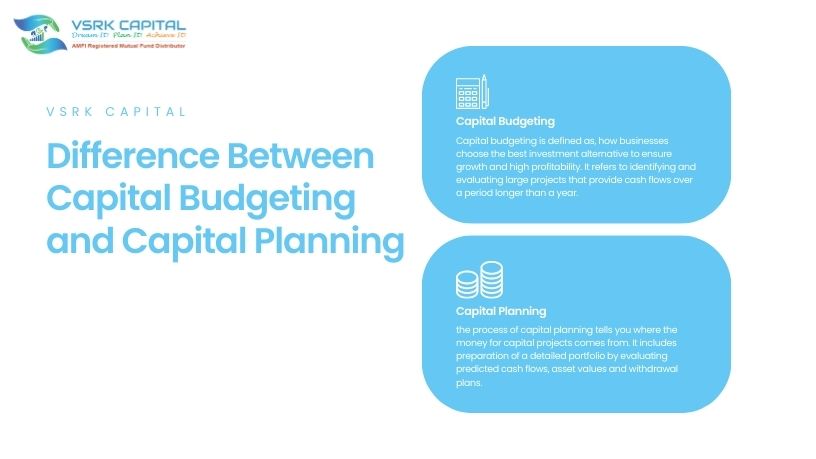
Capital budgeting is defined as, how businesses choose the best investment alternative to ensure growth and high profitability. It refers to identifying and evaluating large projects that provide cash flows over a period longer than a year. It helps an organization to decide whether or not an organization should fund a specific long term investment. It is the process to evaluate potential major projects or investments. Such methods are often used where a big long term investment is made such as procurement of new machinery, construction of a new plant and acquiring other businesses. Capital budgeting involves the valuation of a company’s lifetime cash inflows and outflows from a project to determine whether the decisions of investing in that project are feasible or not. On the other hand, the process of capital planning tells you where the money for capital projects comes from. It includes preparation of a detailed portfolio by evaluating predicted cash flows, asset values and withdrawal plans. It also provides a roadmap to meet the goals and objectives strategized by the businesses. Capital planning contains several processes that business owners follow while accomplishing various goals. It is the is a comprehensive evaluation of an organization’s current pay and future financial state by using current known variables to predict future income, asset values and withdrawal plans.

Capital budgeting, thus, determines what investments an organization makes by evaluating the expected cash inflows, initial outlays and scrap value of the asset after expiry. Whereas, Capital planning deals with the questions of how this selected investment would be funded after evaluating an organization’s overall cash inflow, cash outflow, asset values and withdrawal plans.

What Is the Debt-Snowball Method?

Debt Snowball Method

Legendary investor, Warren Buffet has called the power of compounding- the eighth wonder of the world. Compounding is the process in which an asset’s earnings are reinvested to generate additional earnings over time. This return can be in the form of interest, dividend or capital gains. Compounding can be explained as interest on interest- the effect of which is to magnify returns to interest over time, this is also known as the “miracle of compounding”. This can very well be understood by the example of a snowball.

Have you thought what happens when you push a small snowball down a hill? When you push it down a hill, it continuously picks up more snow. By the time it reaches the bottom of the hill it is a giant snow boulder. While falling downhill it gets bigger with every revolution. The same happens with money, if you invest INR 100 for 2 years at 10% compound interest p.a., at the end of 1st year you have INR 110. Now, for the second year, the whole INR 110 is reinvested. So you get interest in this INR 110. Therefore, you get INR 121 at the end of the second year.

It is not a secret anymore that you can grow the money you save by investing it to earn a return. You can make your money grow faster if you reinvest the returns along with the principle amount. Various investments like savings accounts, fixed deposits, recurring deposits and bonds pay interest. Such investments provide you with clarity as exactly how much money you’re going to earn. Here, you still benefit from compounding by reinvesting your earnings on other investments, like stocks, mutual funds and exchange-traded funds.
Additionally, Rule 72 is a highly used method for understanding the application of the power of compounding. It is a technique to identify at what period would a particular sum of money double it at a given rate of interest. It requires you to divide the number 72 by the rate of interest. For example- if you invest a sum of money in a fixed deposit at an interest rate of 8% p.a. it would take 9 years for you to double the amount (72/8).

Top 5 Reasons to Start Investing Money For Future Financial Stability

Top 5 Reasons to Start Investing Money For Future Financial Stability-23

Investing refers to the process of setting out a certain sum of money for a set purpose and participating in certain securities which help in the achievement of the objective for which such investments are created. The sole purpose of such investment is to earn profits in the course of investment in such funds & securities.

Diversify your assets & associated risks

Economic assets are of essential value to our livelihood especially in times of extreme difficulties such as the ongoing pandemic. Distributing your money into several modes of investment and investing in various securities helps us to minimize the associated risks.

Saving money loses to inflation

After making the necessary expenses a lot of us set aside the amount left. However, due to the effects of inflation and the concept of time value of money such amounts kept in our wallets or savings bank accounts continuously lose their actual value.

For example- If the rate of inflation is 2% per annum and you could buy 1 kg apple for INR 100 toda, the next year it would cost INR 102 for the same 1 kg of apples and similarly after 10 years the same 1 kg apple would cost you around INR 120.

Due to the inherent limitation of time value, saving is not the best option. Investing such saved funds helps you fight the effects of inflation by generating returns in the form of dividend or interests or in such other manner as maybe applicable.

Increases earning potential

Making informed investment helps you in many ways such as reducing the risks of losing all the money by diversification as well as generating revenues in the form of interest, dividend, etc. Such extra income helps in increasing the earning potential in many ways. You may use the extra amount in starting a new venture, initiating a side hustle or just further investing such an amount.

Power of compounding

Compounding is said to be the 8th wonder of the world. The power of compounding could be understood by the following example- if you start investing INR 500 month for the next 40 years at 18% interest rate per annum the total investment over the period would be just INR 2.4 Lac but the accumulated value received would be INR 4.29 Crores.

Get tax benefits

The Income Tax Act provides various exemptions and deductions from the taxable income. So, for example- if you were falling under the 30% tax slab and you make an eligible investment of INR 1 Lac you save around INR 30,000 just by making such an investment as you won’t have to pay the tax on the same.

5 Things To Know Before Hiring Financial Advisor

Financial Advisor

Who is a financial advisor?

A financial advisor is an investment professional who is an expert when it comes to managing your saving and other investment related problems. They help you to draw up investment plans, choose the best investment alternative amongst the pool of choices available and enable you to fulfill your wealth related objectives. 

Why to consult financial advisor?

Ever tried flying an aircraft on your own? Some of you might have yes as an answer which has been supported by years of intense training and experience of flying a plane. Managing your wealth could be just the same as flying an airplane. 

If you know how to fly it you’d be in the clouds but if you don’t your life could be at high risk so it is advisable to let the pilot handle the yoke. Similarly, if you lack the necessary skill & knowledge of managing investments you should consider a financial planner.  

There are a lot of changes in the ever changing market; a majority of individuals are unable to understand the dynamicity which usually causes a major loss to the investors. Therefore, a financial planner is one that you should consider before investing your hard earned money.

Following are the list of factors that you should consider before appointing a financial advisor.

  • Decide whether you need a financial advisor

Considering a financial advisor is always a good thing to go for, but the advice usually carries a brokerage or commission. This decision normally depends upon the investor’s knowledge, education and other related factors. If you have a strong knowledge of the fields of finance and generally keep yourself updated you might skip the option of hiring a financial advisor. Otherwise it is highly recommend considering a financial advisor. 

  • Find a Reputable Advisor

Before consulting a financial advisor, you must check his reputation, feedback & reviews of the past and current clients.  There are a lot of financial advisory firms available in the markets which have good repute and a loyal customer base which makes your investment safer.  

  • Past performance of the financial advisor 

Before investing your hard earned money you should be aware of the past tracking records of the financial advisor. A lot of people are shy about asking for proof that whether their financial planner actually has a successful track record managing accounts.   

  • The Education Level & Certifications of the financial planner 

The government has various certification & education bodies which skeptically check the competence of the financial planner. Such certifications are an assurance that the individual which you are referring to is a genuine expert in the fields of investment and has a better command over understanding the dynamics of the market. 

  • Know when to consult a new advisor

There could be a lot of possible situations where you might want to shift to a new financial planner in place of the current one. A good advisor is one which understands your investment needs, has multiple conversations with you, discussing your long term goals and assessing your plan. If you feel that your advisor is not able to serve to your expectations, give good suggestions or is unable to help you achieve your investment objectives you should consider a new business planner.

Who is VSRK?

VSRK is one of the financial advisory firms in Delhi, giving advisory on mutual funds, life insurance, general insurance, pre-IPO, PMF, IVF and other structured financial products. 

Why should you choose us?

Here at VSRK we advise about your financial needs at different level of your age, be it for your child’s education, pension plans, medical insurance plans or making huge investments for profitable businesses. That’s what makes us one of the best financial business planners in Delhi

Our awards

  • VSRK has been a member of UTI Mutual Fund Chairman Club since 2008.  
  • VSRK has been awarded as wealth management firms in Delhi by Pan India in Distribution of UTI Mutual Fund products in IFA Category for the year 2009-2010.

VSRK has also been awarded IFA Category WEALTH FORUM Advisor Award – 2010 for Highest Growth in AUM Equity + Hybrid), North Zone – Delhi Region for financial business planner in Delhi

A Crash Course on Property Management for First-Timers

A Crash Course on Property Management for First-Timers

When you purchase your first rental property, there are some critical factors that you need to be assessed. As Redfin explains, you need to determine how much you can charge for rent by taking features such as location, home size, and recent updates into consideration. You also need to determine how much investment you’re willing to put toward the property and whether it’s sufficient enough to receive a return. Also, don’t forget to consider what tenants may be looking for and who will be managing the property before making any final purchases. 

Get the Proper Insurance Coverage 

Every form of business opens you up to potential lawsuits and other legal actions; property management is no exception to this rule. Before rent out your first property, invest in the proper insurance policies. Professional liability insurance, also known as errors and omissions, is a great starting point. This coverage will help to protect your business, properties, and subcontractors from specific claims involving negligence other related incidences. Talk with an insurance agent to see which policy is best for you. 

Choose Your Tenants Wisely 

Finding tenants for a property is much more complicated than selling a product or service. As the owner and manager of the property, you’ll be entrusting renters with your investment and assets. You’ll have some insurance coverage and legal protection, but you don’t want to solely rely on them. Instead, take some time to carefully find tenants who are trustworthy, financially stable, and clear of any criminal history. It’s common for property managers to have a screening process for weeding out unreliable tenants. You should always look for ways to protect your property and your investment. 

Find a Property That Is Easy to Manage 

Not every rental property will pose the same challenge for you as a property manager. There are some that will be much more difficult to manage due to their age, size, and location. When choosing your first rental property, you’ll want to find something that is fairly easy to manage. This way, you’ll have enough time to focus on the business side of your role as the property manager. Finding something that is small, relatively new, and located near your own home is a great place to start. 

Keep Accurate Records 

Even though you’re not selling a service or good, you’ll still end up doing a lot of paperwork as a property manager. In order to keep everything organized, you need to maintain accurate records. This includes your legal paperwork, transaction history, permits, licenses, and other important information. Whether you need to update a legal document or confirm last month’s payment for a tenant, having detailed records will make it easy to run your company successfully. 

Investing in your first rental property is an equally exciting and stressful endeavor. As a beginner, don’t let the size and complexity of the real estate market shatter your goals. With the right strategies and some hard work, you’ll be on your way to creating a financially stable future through real estate. 

Investment Solutions For the People Who Don’t Have Enough Money to Invest

People With Lower Incomes Have More Struggles

People with lower incomes have more struggles. They don’t have enough money for investing. In most cases they don’t have enough money left over after paying the expenses of daily life. The old saying says that money to make money clearly says it all. You should definitely have some  money or wealth to invest for the future sake. It is also true that if you don’t plan money management for the future and uninvited adversaries you will have to face big trouble. If someday you won’t be able to work and have enough savings for living that what you will you do in that case. Well to avoid these situations it is very important to plan investments.

We after talking to Best Wealth Management Companies in Delhi NCR put together some ideas for the people who don’t have enough funds to invest. There are many small funding Schemes in which you can invest :-

DRIPS (Dividend Reinvestment Plan)–  DRIPS, allow you to invest small amounts of money into dividend-paying stock, by purchasing directly from the company. Companies that allow you to make regular purchases of very small amounts of stock, and reinvest the dividends. This can add up to a big investment over time and, as you gain a larger balance, you may consider diverting some of these funds into other investments.

ETFs (exchange-traded funds)-  ETFs,or exchange-traded funds, are financial products that track the performance of a certain sector of the investment market. You can buy as little as one share of an ETF through a broker, and some of these ETFs track the performance of the total stock market, the bond market, and many others.

Target Date Funds- Target date funds, as the name implies, target your retirement date by changing the percentage of stocks and bonds to assure that your money remains safe as you approach retirement age.

If you want to hire Professional Financial Services for your business and funds investment you can contact to VSRK Wealth, one of the Investment Services Company in Delhi.